
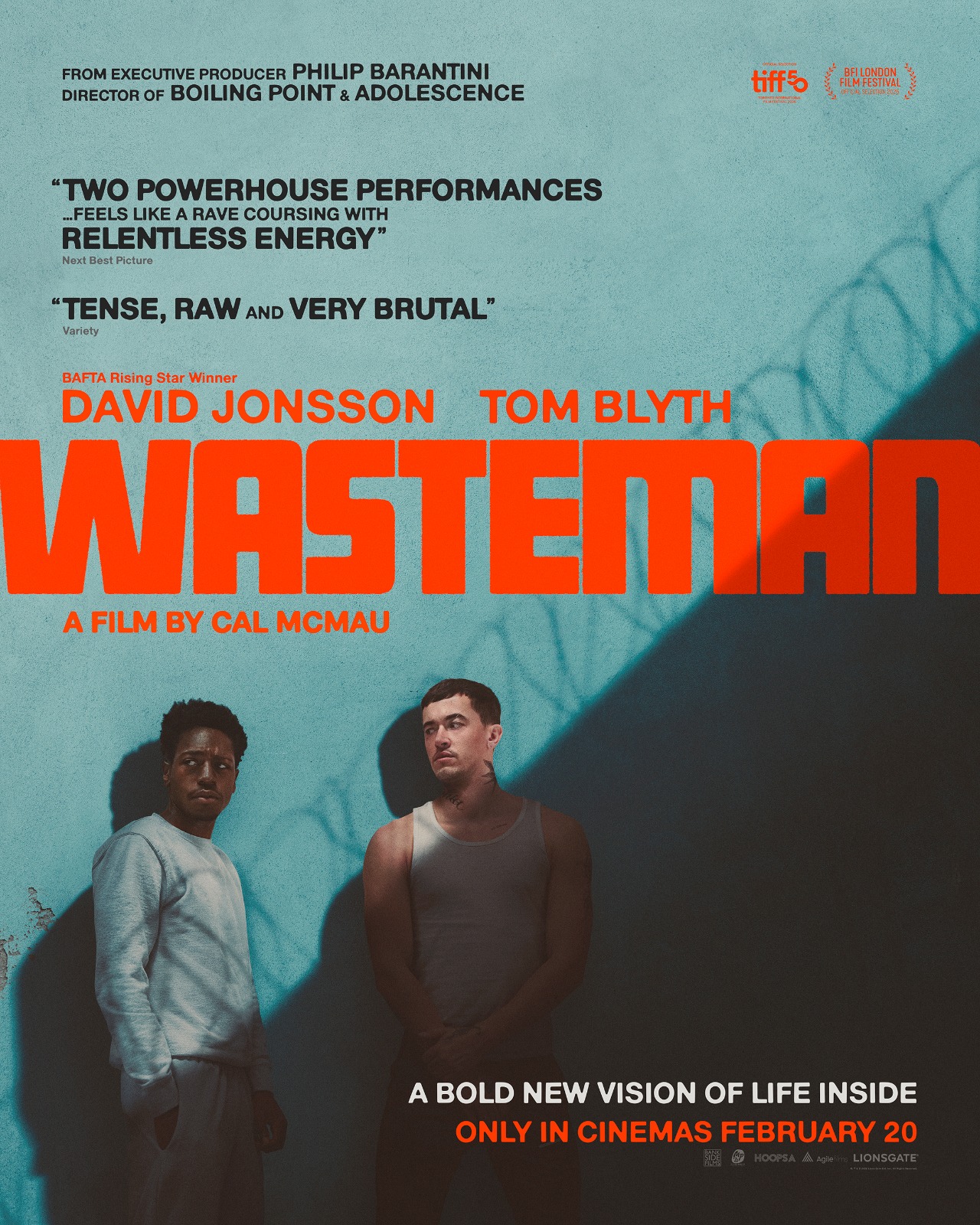
Switchback first met director Cal McMau back in 2024. What started out as a casting request for a new prison thriller film ended up sparking a nearly two-year relationship with Switchback.
Along with actor David Jonsson, producer Sophia Gibber and key members of the WASTEMAN crew, Cal came and met with Switchback and our Experts by Experience Board (EBE) to hear real experiences of the prison system first hand.
Co-lead actor Tom Blyth and the rest of the crew soon followed, and Switchback worked with the team throughout the production process – with some men also starring in the film – to create an authentic representation of the current state of UK prisons. And most importantly, it’s failure to rehabilitate people.
Switchback Communications and Campaigns Manager Amy Davidson sat down with Cal to talk about WASTEMAN and how everything – from the characters and cinematography to music and messaging – came together to create what is being lauded as “the new best prison film of all time.”
What was the inspiration behind Wasteman?
“In film, it’s been really exciting watching an evolution every 10 years or so. When Paul Greengrass, who directed films like Bloody Sunday and Captain Phillips, did a documentary aesthetic it was completely new at that point to cinema. I found it exhilarating. It was much more truthful than previous depictions with the steady cam and the smooth, big Hollywood style.
Then in 2015 there was a film called Victoria, which was all in one shot, and it was utterly immersive. It was a completely different technique that evolved film. So with Wasteman I was thinking ‘What’s this new thing that’s exciting and a way in which cinema can evolve?’
It was around that time that I started finding all this incredible footage by inmates smuggling phones into the prison cells. The stuff was just jaw dropping; what they were getting up to, what they were getting into the prisons and also this very modern depiction of a synthetic, Neo-world.
It was different to all previous depictions of prison, which almost seem like they’re from the ‘60s in comparison. It was true to contemporary society as well, where we’re all on our phones. The textual quality of the phone footage also brought a truthfulness to it, which was incredible. That was the original inspiration for wanting to make something in that world.”
How did Switchback influence and enrich the film?
“I’d done years and years’ worth of research where I was online finding more and more of this phone footage, which was, as I said, the most truthful thing there is. I was constantly screen recording everything for years, and I built up this big hard drive full of all that sort of stuff.
So I had very good, clear visual research. But what I didn’t have was a clearer emotional depiction of that experience. When we talked to Switchback we started to get the truth of how you feel [in prison]. The guys we spoke to were unbelievably candid and lovely – amazing in their openness and honesty in which they shared the truth of how they felt in various stages of their incarceration.”
How important is it for prison leavers to use their voices in that way?
“I think it’s so important to listen to previous inmates and learn from their experience as to whether it was something that they could grow from. Did it help society or hurt society? It’s becoming very clear as we speak to people that at present, I don’t think we’re doing enough. The more we analyse the current situation, the more we speak to them and find out what their experience was, the more we can hopefully remedy that situation.”
Did anything surprise you when you were working with prison leavers?
“I was surprised at just how unhelpful the experience had been. Obviously no one expects prison to be a bed of roses. But I was nervous that I might have been depicting a left wing cliche in certain situations that might have been bent by some sort of politics.
But the more I spoke to them, the more the distinct clarity of their shared experience all pointed very clearly in the same direction. There was never a moment of some people who managed to get some work out of [prison] and move on with their lives.
It always pointed very, very clearly in the same direction. It was interesting speaking to prison officers as well who had PTSD. It was like ‘Wow, everyone suffered in that experience.’ There was no redeeming quality to it.”

Switchback on the WASTEMAN set
What shocked you the most when you were learning about the prison system in general?
“A big thing was the amount of mental health issues and drug addiction in prison. It was all mixed together in this big mess that felt like, if you had the budget, you could fix. There’s a lot of opportunity to fix a lot of wrongs there. You could majorly prevent a lot of crime. I was incredulous at how great an opportunity we’ve got to fix things and how much this open goal was being missed by politicians.”
What do you want people to take away from the film when it comes to the justice system?
“Many people would agree that the justice system isn’t working. It could sound like a left wing cliche to be sympathetic to prisoners, but I like to try and take the politics out of it and think more pragmatically. Whatever your political standing is, it’s in everyone’s interests to address the situation within prisons because whoever you are, it will affect you. These guys are coming out and they’re not rehabilitated, and it goes in a circle.”
Music plays a big role in WASTEMAN, and it sounds different to a lot of prison films. What was the thinking behind that?
“There’s this Jamie XX track that I’d used very early in a mood film. I took some of this footage and placed it all together. There was something so exciting about it and I knew that from the beginning I really wanted it.
There’s also an element that related to something that was new that I found in this footage, which was that sometimes in prisons, very occasionally, people enjoy themselves. And it’s the truth of humanity, that no matter where, in most situations people will find a way to have that little spark. It might not be very often, but some of them have found a way to have those occasional moments, and that was quite novel.
Often in prison films there’s that focus on only showing the absolute hell. It usually is an absolute hell for most of those stories, but I thought it was interesting to show little pockets of reality. The Jamie XX track really expressed that moment quite nicely.
From there, I knew that it was going to be electronic music. And then I found Forest Swords, the composer who did our soundtrack. There was one track that I listened to called ‘Crow’. It was EDM so it fit with the general direction, but it also had this shrill, almost anxiety to it that sounds like a thriller soundtrack already.
So I was all ‘Wicked. We’ll take that and I’ll take the composer as well, please!’ We got the same guy that would bring this aesthetic to everything.”
 That Jamie XX song is just a banger as well.

“Exactly. It was really nice where it happens in the film, because you’re about a third of the way in and I think you want to get even more immersed in things. It’s just really fun seeing things kick off at that moment.”
Do you think that David and Tom’s characters’ (Taylor and Dee) lives could have turned out differently had they been given that chance at rehabilitation?
“Definitely. The story is a thriller, but it’s also a tragedy. There’s a sub-story, which is the fact that prison isn’t working; the tragedy is that Taylor (David Jonsson) was unable to get the help that he needed to clean up. So he’s in a compromised position.
Then you’ve got the second tragedy, which is that the prison put this guy (Tom Blyth) in a cell with him, and you’ve got the third tragedy that that guy wasn’t getting the therapy that maybe could have helped him.
It’s a series of tragedies within the prison system that led to this situation. Even though Wasteman is a character-driven thriller, a big player is the prison system and its ineffectiveness.”
What notes did you give Tom and David to help with their characters?
“This is my first film, so I didn’t know how to work with actors. A couple of weeks before we started shooting, I read a book on how to, and the key thing I learned was don’t prescribe things. Instead, you’ve got to give them the back story, then they’ll react accordingly.
With Tom, I was very keen that he needed to be absolutely terrifying. I remember saying to him: ‘If you need to be a nightmare on set, I’ll never say this to any other actor, but I’m giving you a pass’. The film rests so much on him being scary.
We had this idea that maybe we’ll keep Tom and David separate, because the film was about them getting to know each other and it would make it all more authentic. But Tom was very keen to go the complete opposite direction, because he knew how hard we were going to go. When we got physical, he needed to feel comfortable that David wasn’t going to reproach him for it, or for punching him too hard by mistake, or something going wrong.
So instead they became best mates. They went out drinking way too much and they’re annoyingly good friends. It was absolutely the best thing to do, because there are fight scenes where they had the confidence to be able to, frankly, fight each other. They could only do that because they had that trust, so they knew that if someone got hurt, they were cool with each other.”
Finally, are you done with prison and the justice system now, or do you think it’s something you want to draw more out of creatively?
“I’m done with it for now. I’ve been ‘living’ in prison for the eight years that this project’s been going on, researching it. I’ve had a lot of dreams about being in prison. I don’t think they were just a reflection of looking at prisons. I think they were symbolic of, actually, project-wise, being in a sort of creative prison, because I’ve been focused on the same film for so long. I think I’m ready to explore some different stuff.
But I think when you’ve worked on something this long, it makes an indelible mark. Especially through working with the Switchback guys, which brought us a profoundness to production that most other films don’t have.
We had (former Switchback Trainee and Mentor) Kam there. I saw him as our spiritual leader. With any art form, underneath it is the thing of ‘What’s it all about? What’s the spiritual energy of the film?’ Kam and Switchback really brought that in in such a deep way. That will always stay with me. So I definitely want to revisit it in the future, and I’m keen to do as much work as I can for Switchback.”
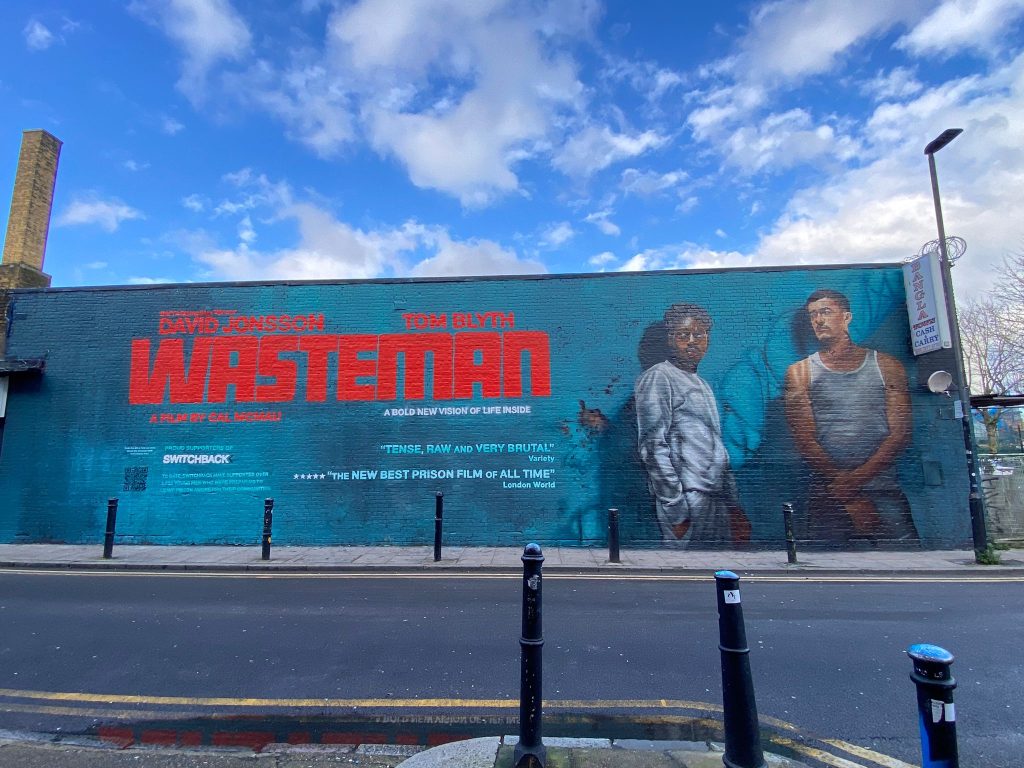
WASTEMAN is in cinemas on 20th February.
